Tuesday, August 1, 2017

Riding the Rail Trails of Northampton, Amherst, and Beyond

This past Saturday, I did a 30+ mile ride on the beautiful rail trails that connect the Massachusetts towns of Florence, Northampton, Hadley, and Amherst.

So let's jump right into the action with my very first posted GoPro video!  I mounted the GoPro Hero Session camera on the handlebars of my Brompton bicycle and then edited it in GoPro Studio.


And now for the details of this great ride...

I woke up at 4:15 AM on Saturday morning, and by 5:00 AM I had my Brompton, helmet, Brompton bag, and supplies packed away my rented ZipCar, ready to go.  I stopped at my local Dunkin' Donuts for my morning coffee...


...and then headed west!

Around 2.5 hours later I arrived at Look Park in Florence, Massachusetts -- a good starting place for riding the Mass. Central Rail Trail, which turns into the Norwottuck Rail Trail in neighboring Northampton.

This area is known as the Five College region, named after University of Massachusetts-Amherst, Smith College, Mount Holyoke College, Amherst College, and Hampshire College.  Far away from any big cities and anchored by the towns of Northampton and Amherst, this a land of rolling hills, farms, and villages.  And much of it is now connected by bike paths and bike lanes.

Here's where I joined the Mass. Central Rail Trail at Look Park:


In Northampton I rode by the old train station (now a restaurant)...


...made my way down a quiet side street (lovely sunflowers)..,


and then joined the Norwottuck Rail Trail, which runs from Northampton, through Hadley and Amherst, and ends on a rural road by the swamps outside Belchertown.

The rail trail follows the route of old the train tracks that used to run from Northampton all the way to Cambridge, Massachusetts.  Passenger service ended in the 1930's, partly because of damage sustained during the Hurricane of 1938.

The Norwottuck begins with a grand start, as you cross the old railroad bridge that spans the mighty Connecticut River.


From there the path heads east through peaceful farmland.
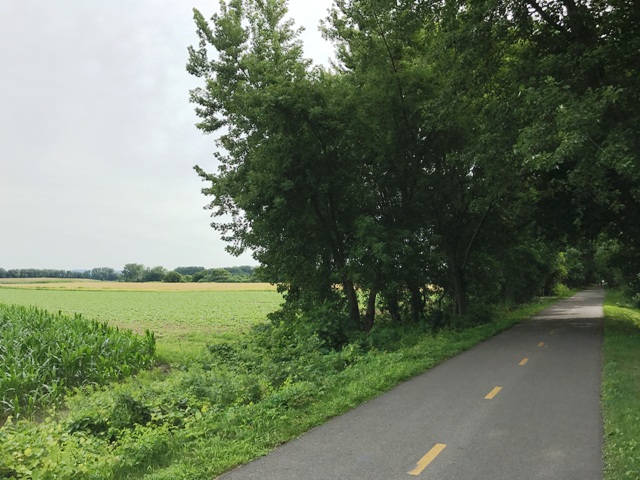


The photo below is of a place I stopped for a good long while, watching the tree swallows dart about catching flies.  They're tough to photograph, but you can see two of them zipping by in this picture (I just realized that I missed a great GoPro video opportunity!  Oh well, next time!):


All along the path were places where the trail branched off and led to streets taking you into the towns along the route, like Hadley and Amherst.  I decided on this trip to stay on the main path and then check out some of the towns on the drive back home.  I've learned from past rides that it's usually a good idea to set these kinds of priorities in advance, otherwise you try to see too much, get exhausted, and can't fully enjoy all you experience.

The most magical part of the Norwottuck Path lies just beyond Amherst, where it enters the swamps of the Brickyard Conservation area.


At the risk of getting over-dramatic here, I must say that standing in this spot really affected me deeply.  It was so quiet, with nothing but the sounds of birds, critters, the wind, and the cyclists and walkers on the path.  Living in an urban area, I'd forgotten how quiet the natural world can be.  Although I saw very few birds (I was hoping to jot down more sightings in the front cover of my Peterson's Field Guide to Birds of North America book!), I could certainly hear them, and I imagined so many little animals call this beautiful swamp home.

On my return trip, I passed by this sign:
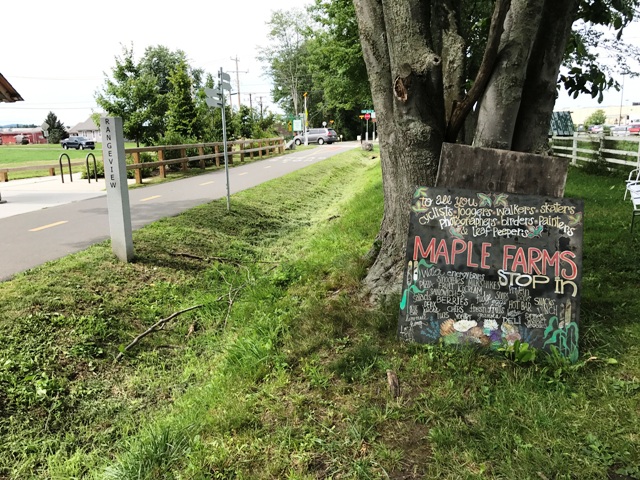

So of course I had to stop in to get a bite to eat!  I purchased some very good cornbread.


This is a good time to add that the Brompton rode like a dream on this trip.  It's so remarkably comfortable, even over long miles.

Arriving back at my ZipCar....


I decided to explore Look Park a bit.  It's such a cool place!  There's a little narrow gauge railroad for kids, paddle boats, picnic areas, and beautiful landscaping. I must come back another day and explore this park further.


For my drive home, I decided to take local Route 9 for most of the way back to Boston, rather than the Mass. Pike. In doing so, I made a remarkable discovery...

Although I drove back through the lovely villages and farmland that I saw from the bike path, I also drove through vast areas full of fast food restaurants, malls, and big box stores -- all of which I could tell from Googlemaps were very close to the bike path!  It was as if the path lived in a quiet world all its own, just out of view of 21st-century suburban life.  That being said, I enjoyed driving by all the malls, box stores, and fast food restaurants too. 

As a final treat, Route 9 took me by the huge Quabbin Reservoir.  You can actually walk over the earthen dam that was built in the 1930's to flood the area and create the reservoir.


It's a pretty overwhelming site.  It reminded me of pictures I've seen of fjords in Norway.  The four towns of Dana, Enfield, Greenwich, and Prescott were actually disincorporated so that the area could be flooded for the Quabbin.  Roads and foundations of old houses apparently still exist deep below the water's surface.  It's a place full of history and somewhat haunting beauty.

So to wrap up, last Saturday I explored a region of my home state that was totally unfamiliar to me, and it turned into a  great adventure.  Massachusetts really is a remarkable place.

Saturday, December 10, 2016

It's like taking my bike back to its ancestral home.

That's what I thought as I dropped my Brompton off at the Harris Cyclery bike shop for its yearly tune-up.  Only thing ... it hadn't been one year, but two years since I picked up my cobalt blue Brompton from this same shop in the fall of 2014, fresh from its trans-Atlantic voyage from the Brompton factory in London.  I was only now bringing the bike back to the shop for routine check-ups and maintenance.

There are two reasons why I waited so long.  First, I keep my bike in good shape.  I lubricate the chain every month or so, I keep the tires at the full 100 psi, and I make minor adjustments when needed.  Second, the Brompton is a wonderfully well-built bicycle!

Taking the bike in for a yearly tune-up really is a good idea though, even if simply to reconnect with your local shop.  I dropped it off on a Thursday, and by Friday afternoon it was ready to pick up.  So on Saturday morning I took the 10:40 train from Boston's South Station...


...out to West Newton, and then walked about three minutes to the bike shop.


The shop is on the left side of the street in the above photo, with the blue and while awning.  I love the beautiful neo-gothic/tudor cathedral across the street.


I picked-up my bike, paid for the tune-up, and chatted with Elton, Harris Cyclery's resident Brompton expert, mainly about the updates Brompton has made to their 2017 models. 

I then decided to ride my bike back home in a particularly Brompton-specific style.  I'd ride as long as I wanted, and then fold up my bike and hop on the subway for the rest of the journey.  I brought my helmet with me, of course.

And so from Harris Cyclery I rode along the Charles River bike path all the way to Harvard Square in Cambridge, got on the T but decided it was more fun riding.  So I got off one stop later at Central Square and rode the bike lanes all the way through Cambridge and Boston to my home on the South Shore.

I didn't take many photos, and the ones I did take don't do the ride justice.  But here are some from a lovely bridge across the Charles River in Newton...


... one of a sign showing that the Charles River bike path is part of the ever-growing East Coast Greenway...


...and a photo of one of the many university-owned rowing houses along the river.


Saturday, August 13, 2016

My Brompton Interview

I'm featured on Brompton's website!


You can read my interview here.

Thanks so much to BromptonUSA for contacting me and running this feature.  I had a great time answering their questions.

Sunday, March 13, 2016

Magical Morning Brompton Ride

With winter 2016 quickly becoming history, I welcomed in spring this past Saturday with a long Brompton bike ride from my home on Boston's South Shore all the way to Harvard Square in Cambridge.  I saw so many wonderful things along the way.

I rode the bike lanes through Dorchester, by the neighborhood's iconic triple-deckers:


Then after a quick dash up D Street in South Boston, I stopped to rest on one of the wide benches that line the Seaport District, looking out on the commercial fishing boats that dock at Boston Fish Pier.  Here's a watercolor I did of that scene when I got home (click to enlarge):


After my short break by the pier, I continued riding along Atlantic Avenue's bike lanes into downtown Boston, stopping for breakfast at the Equal Exchange Cafe coffee shop near Boston Garden:


Normally this sidewalk would be full of people, especially after a basketball or hockey game at the Garden.  But it 7:00 AM on a Saturday, so all was quiet.

How nice it was to simply bring my neatly folded Brompton inside and tuck it under the table as I ordered a bagel and iced coffee from the friendly staff.


Another great thing about the Brompton is that because of its small size, it's easy to walk the bike to become a pedestrian when necessary.  This allowed me to  make my way from Boston to Cambridge along one of the city's most magical secret spaces ... the network of little public bridges and catwalks across the Charles River locks:


My meandering journey across the river was rewarded by this view of the Zakim Bunker Hill Bridge...


... and a chance to have a little fun playing the "Charlestown Bells" -- an interactive work of public art by Henri Matisse's grandson, Paul Matisse.  You pull various handles to ring the tubular bells that span the walkway's fence.


Each handle even has the note it plays etched into the steel.

I then got back on my bike and rode the paths through the fairly new Paul Revere and North Point Parks.  The magical thing about Paul Revere Park is that it makes accessible -- and beautiful -- a space that is usually left to become to dark, dusty, and dangerous: the space beneath the bridge:


I'll have to take a better photo of this sometime, because the picture I took doesn't capture how light, cool, and fun this area is.  There are always people around, strolling, running, walking their dogs, or just enjoying the sun.  And directly under the bridge are stone sculptures, a skateboard park, and then a pedestrian/bike bridge that lifts you out from under the bridge into the beautiful garden area of playgrounds, landscaping, and well-tended bike lanes that is Cambridge's North Point Park.  In fact, the bike path is part of the Maine-to-Florida East Coast Greenway.


The Greenway has a long, long way to go before being complete.  But hopefully someday the dream will become a reality.

I then continued my ride onto the bike lanes of Kendall Square and MIT, some of which are completely separated from the street.


Above is the ultra-modern Stata Center at MIT.

Turning onto the bike lanes of Mass. Ave, it wasn't long until I reached my destination: Harvard Square.  I didn't take any photos there, mainly because I've been to Harvard Square thousands of times.  But you can read about its bike lanes on this earlier post I wrote.

Happy with this long and wonderful ride, I decided it was time to head home.  So I hopped on the Red Line subway for a quick dash back to the South Shore (again, super-easy with a folded Brompton).  But unfortunately I forgot that the T was doing construction that day along the Longfellow Bridge between Cambridge and Boston.  So they were busing passengers over that part of the route.  Argh!

I could have simply carried my Brompton on the bus, but instead I got back on my bike at Kendall Square and retraced my route along the North Point Park bike paths...


... over the creaky gangways of the Charles River Locks...


... and into the North End, where I took a long way around, leading me to this:


This is a very special section of the Rose Kennedy Greenway, the linear park that snakes its way through downtown along the old path of the I-93 elevated highway.  The highway now runs underground -- the end result of the tumultuous Big Dig project that I was a witness to for well over a decade.  This section of the Greenway is designated the Armenian Heritage Park, honoring metro-Boston's large Armenian community.

The labyrinth and the dark polygonal sculpture (on the upper-left of the labyrinth) represent the constantly growing and unfolding immigrant experience.  The sculpture is reconfigured each year into a new shape, symbolizing the different ways immigrants reshape their own lives in their new home.  The sculpture is dedicated to the lives lost in the Armenian Genocide of 1915-1923.

I stopped here for a bit to take in the meaning of this space, and then I rejoined downtown Boston's bike lanes to ride on to South Station where I folded up my Brompton, got back on the Red Line, and completed my journey home.

Saturday, March 5, 2016

Urban Sketching Practice Paintings

I've been reading a lot about urban sketching over the past couple weeks.  The term "urban sketching" took on the qualities of a movement in 2007 when journalist Gabriel Campanario created an online forum for...

"all sketchers out there who love to draw the cities where they live and visit, from the windows of their homes, from a cafe, at a park, standing by a street corner ... always on location, not from photos or memory."

This quote by Gariel Campanario is from the wonderful urban sketching website.

Well, reading about all this, it occurred to me that urban sketching seems tailor-made for cycling!  You load up portable painting or sketching supplies into your bike bag, go out, explore, and paint or sketch on-the-spot.  Why haven't I thought of this sooner?!

So although it's still too cold here in Boston to give this a try now, I've been practicing painting at home in anticipation.  I think I'll take a watercolor class some day, but not yet.  I first want to learn as much as I can from getting out there and painting on my own.

For instance, this week I did two paintings that really taught me a lot.  One is from a scene I saw on TV of a train heading up the tracks in a hilly region of northern Japan...


 ...and my second painting is from right here in Boston, standing at the corner of Arlington and Beacon Streets, with the Public Gardens on the right.  It was too cold to stand there for very long, so I took a photo on my iPhone and worked off of that:


For my first painting I used these tools:


And for the second painting I used these:


You may be saying to yourself, "hey, where's your brush"?  Well, it's actually that strange-looking light-bluish object.  It's called a water brush, and I saw it on a YouTube video about painting on-location, as well as in books.  You fill the back part of the brush with water and then gently squeeze it to make the brush wet.

I bought a water brush model made by Pentel at the wonderful Blick art supply store here in Boston.  My father always uses .05mm Pentel mechanical pencils, so I have a special affinity for that brand.  Pentel's "Aquash" water brush uses very little water, doesn't drip, and it comes with a firm cap.  You can load it up with water in the morning and keep it in your bag all day long.  It doesn't give you as much control as a regular brush, but it's still remarkably useful -- and it solves the issue of having to carry water and a cup, which is kind of cumbersome (I actually worked on part of Painting #2 in a coffee shop!).

For both paintings, I used watercolor pencils, which work like regular colored pencils until you make them wet, turning them into paint.  I especially enjoyed using the watercolor pencils in my second painting in conjunction with regular pan paints.  The pencils allowed me to add more detailed colors in small spaces.

So what did I learn from these two paintings?  Let's go in depth!

Painting #1


What I like:
  • It was a fast painting, taking me only around 30-45 minutes.
  • I think I managed to capture a sense of perspective and depth, which makes it interesting.
  • I like that it has the feel of a travel-painting, done on the spur of the moment in a notebook.
What I learned:
  • A few more small details would add personality to the landscape.
  • Some shadows would give the houses more depth.
  • Although I like the colors, I could have had even more fun with them.
Painting #2


What I like:
  • This took me about 2.5 hours, since I tried to add more details than in Painting #1.  I'm pretty happy with some of those details, like the brownstone roofs, the lampposts, and the trees.
  • I added all sorts of colors to the brownstones, and I think it works.  They are still red-brick, but a dash of yellow or blue really makes them more interesting.
  • Having never painted people this large before, I think they're a pretty good start.
  • I did a bit of layering with this painting -- adding basic light colors first and then adding details later.  That really worked well.  I later read that layering is an important watercolor technique, so it feels good to have discovered that on my own.
  • I gave shadows a try.
What I learned:
  • The street and cars were a challenge -- but a fascinating challenge, especially in the case of the street.  I painted it black, because I assumed that asphalt is black.  But it turned out way too dark, and made it difficult to add cars and other details.  So I looked more closely at my photo and at my local city streets in real-life, and I realized that streets and roads aren't strictly black at all!  The light can make them light gray, or even close to white when the sun is especially bright.  And then I looked at other street-scene paintings, and artists often depict streets with a light coating of gray, or sometimes just a dash of black to give the feel of asphalt.  How interesting!  I softened my street a little with white paint, but I will simply put this lesson into practice next time around.
  • Cars are tough -- but I think that I can depict them with a little less detail, as I did with people.  That may give them a sense of motion too.
  • Bright colors added to the people would help them to pop off the paper more.
  • The perspective is a bit off, but I kind of like it.  Besides, it will get better with practice.  I notice that my fence doesn't diminish to the vanishing point quickly enough.  So interesting!
  • I think the colors can be even bolder.
This is really fun.  Painting on-location must be even more challenging, because I found myself using the frame of my iPhone photo as a perspective guide.  So, more learning opportunities ahead!