1. The SceneryImagine you're in France. You stop by the village
brasserie to buy some bread and cheese for breakfast, and the old man behind the counter notices the
France 2010 guidebook under your arm. Shaking his head disapprovingly, he pulls a crinkly old map and a red felt-tipped pen out of a drawer, motions you to come closer, and says in a low voice:
"If you really want to see France, forget those books and just follow this."
The man removes the cap from the pen, begins outlining some twisty little roads on the map, and hands it to you.
"
There, my friend,
is where you'll find the real France."
Such is the Tour de France. Most everyone has seen photos of the riders racing down the Champs Elysees with the Arc de Triomphe in the background. But the Tour's heart and soul lies in the little country lanes of the Auvergne, the narrow roads high up in the Pyrenees, and the wind-swept streets along the Brittany coast. The Tour draws its own imaginary red lines on those beautiful routes, highlighting them for all the world to see.
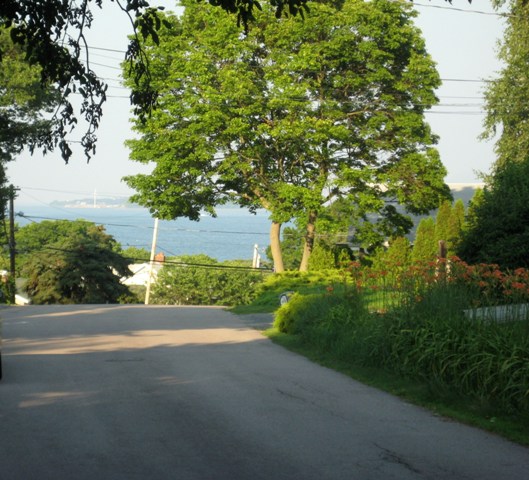
Local races may have highlighted extraordinary roads in your own hometown too. Here's a photo I took on a street near my apartment, with remnants of an old race still visible on the pavement...

...and in Boston, the finish line of the Boston Marathon is always there, recalling memories of it's annual day in the spotlight:
 2. You Have a Need for Speed
Speed is graceful. Speed is fluid. Speed is lean, simple, and uncomplicated. For the cyclist, speed means that all the elements of the road, air, and machine have fallen together in a near-perfect unison. Watching cyclists careen through a town's curving streets, you forget how hard they're working -- how impossibly difficult a Tour de France stage is to win. All you sense is the beauty of the road and the quiet
whoosh of riders racing by their cheering fans.

 What's that you say? You can't make it to France this summer to experience the phenomenon for yourself?
 No worries ... get a feel for it by attending a local bike race! I took the two above photos at the Mayor's Cup Criterium Race here in Boston last fall.
3. Phil and Paul
The Tour de France just wouldn't be the Tour de France without legendary television commentators Phil Liggett and Paul Sherwen. Maybe someday I'll travel to France and see the race in person -- but even then, I'm sure I'll still hear Phil and Paul describing every moment in poetic detail in my mind!
Just as the Tour de France moves with an ever-changing rhythm -- from steep mountains to rolling hills, windswept shore roads to hot Provencal paths -- so does Phil Liggett and Paul Sherwen's commentary ebb and flow with the contour of the race. Is has to. You simply can't listen to excited voices all the time in a month-long event. Rather, Phil and Paul describe the Tour as if they're sitting there in your living room, telling a story.
Simply put, they're wonderful.
4. It's On Every Night!
If you love the Tour de France, then the Tour
is your July. You'll never wake up on a Saturday morning this month and think, "hmm, what shall I do today?" You'll be watching the Tour de France, of course!
5. CollateralThe Tour de France is a storyteller's dream. The wild fans, legendary climbs, small towns, eccentric riders, team cars, cool bikes, frustrating controversies, and colorful maps ... there's so much to write about! And where do you find these stories? In magazines, websites, and books! One of my pre-race rituals is to buy all the Tour de France magazines I can find and read them cover to cover. Here are two that have been accompanying me on my subway commute this past week:
 6. The Strategy
A multi-stage bike race is like a chess match on wheels. You can study the strategy beforehand by reading books and websites (check out my 2009
Beginners Guide to the Tour de France post) ... or you can do what I did and simply let your understanding evolve as you watch the race on T.V.
Beneath all the intricate strategy, though, is one fascinating fact: nobody's place on a cycling team is defined by a set "position" on a field, like a first-baseman or a linebacker. In essence, everyone is equal on the road. It's the choices each rider makes that define the contour of the team. On good Tour de France teams, every riders is comfortable in his appointed role, even if it means sacrificing his own ambitions for the team leader. But watch out! Team leader status is never 100% secure. Falter too much, and nothing can stop one of your teammates from staging a rebellion and sticking it to the boss.
7. The Gear Oh my, those bikes are a thing of beauty...

(Again, I snapped the above photo at the Mayor's Cup Race here in Boston. Local Tour de France equivalents are rarely far away!) One of the most marvelous things about the Tour de France is that all of the bike frames and components used by the pros are the same as those that come right off each company's high-end production line. No custom, one-time builds allowed. As long as you have the money (a lot of money, that is), Lance's Trek Madone can be yours.
8. Cheering for the Underdog
Sure, most of us here in the U.S. are rooting for Lance Armstrong to win. But the beauty of a 20-stage race is that Lance only needs to have the best time at the very end. There are plenty of chances for little known riders to have their moments in the sun too.
For example, Lance Armstrong knows that he's at his best in the mountains, where he'll most likely pull away from over 90% of his fellow riders. So there's no need for Lance to waste energy trying to win a flat stage. That presents a great opportunity for a little-known rider to get into a breakaway and ... if all the stars line up correctly ... pull off a big win that afternoon! It's one of the most thrilling moments all of cycling.
Here's a painting I created illustrating the magic of the lone breakaway (for the full-color version, and the accompanying story I wrote with it, click
here for my earlier post)...
 9. The Fans
In no other sport can fans get as close to the action than in professional cycling ... and Tour de France fans take every opportunity to get as close as possible, sometimes disturbingly so! Crazy fans wave flags and snap photos directly in rider's path, moving away at the very last moment. How the riders keep their concentration is beyond me ... but it's all part of the culture of the race.
10. The Mountains
Think for a moment what a typical photo of a mountain looks like. It usually has a grand, sweeping vista, with a big sky and awesome snow-capped peaks jutting up through the clear blue horizon. About right?
Well this is
not the image you'll come away with when you watch the Tour de France. As the riders follow narrow mountain roads up and up, higher and higher, you'll see every contour of the switchbacks ... feel the rhythm of each inclined slope. You'll sense the inner character of the mountain as it's reflected in the faces of the suffering riders. And as the cyclists make their way above the treeline, the simple shades of the sky, rocks, and grass are punctuated with a kaleidoscope of color created by thousands of wild fans.
Yes, the Tour de France pays respect to the magnificence of the mountains. But more importantly, it makes them wonderfully, thrillingly human.
Now that you've finished reading this post, you may be wondering -- why did I put all my photos and paintings in black & white? Well, the race hasn't happened yet! All the colors of the Tour de France will reveal themselves as this magical month progresses. Stay tuned, and enjoy the start of
Le Tour!